Kerenyi Lajos
Doctor ZhivagoKerenyi Lajos is a Hungarian doctor whose path through the war carries him from service in the Austrian army to prisoner status and conscription into the Red Army, and eventually to medical work with the partisans. The novel gives him a compact but consequential presence: he is remembered as a physician whose treatment helped Anna Ivanovna, then appears as one of Yurii Andreievich Zhivago’s medical colleagues, sharing responsibility for a field ambulance, a pharmacy, and the mounting psychological distress of camp life.
Identity and wartime position
Kerenyi is identified as a Hungarian Communist and a former doctor in the Austrian army. By the time Anna Ivanovna’s family asks about him, he is a prisoner of war living with other Hungarians beyond the demarcation line and has been conscripted into the Red Army. The change in his position captures the way wartime institutions redirect even a trained physician: expertise remains useful, but the doctor himself is moved across military and political boundaries.
His name arises in a discussion of care for Anna Ivanovna. When the doctor she had previously consulted is said to have left town, her daughter proposes Kerenyi, recalling that his treatment had helped her mother before. Anna Ivanovna replies that this is no longer possible: Kerenyi is away with the other Hungarian prisoners and has been conscripted. His absence makes the changing political and military order tangible in the intimate sphere of illness; a once-accessible practitioner cannot be summoned when care is again needed.
Medical work with Yurii Andreievich
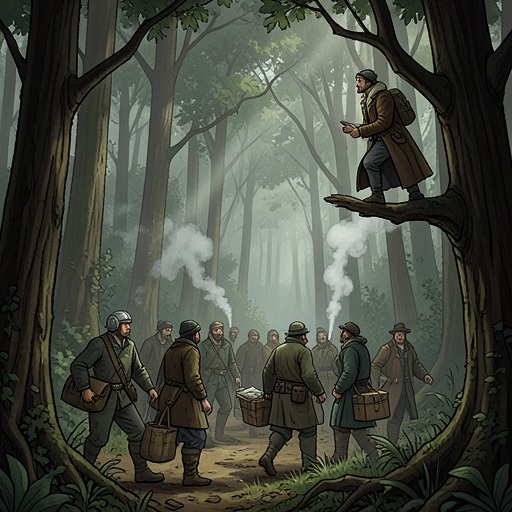
Later, Kerenyi is among the two chief assistants working with Yurii Andreievich in the partisan medical service. He has been newly appointed to the post and brings formal military medical experience from the Austrian army. Yurii speaks German with him, while Kerenyi’s other chief assistant, the Croat Angelar, understands Russian to some degree. The practical arrangements themselves suggest a working environment assembled across languages and national backgrounds, with expertise recruited from men whose earlier service had taken place on opposing sides of the war.
Their collegial relationship is direct and professional. Kerenyi approaches Yurii as a fellow doctor, and the two discuss a range of urgent duties rather than treating medical work as separate from the camp’s political and military conditions. The agenda includes a court-martial involving vodka brewers, reorganization of the field ambulance and pharmacy, and Yurii’s proposal for the treatment of mental illness. Kerenyi is not a passive aide in this exchange: he contributes his own assessment of the camp’s disorder and responds to the proposal as a medical question with wider causes.
Medicine amid upheaval
Kerenyi agrees that preventive psychiatry is relevant, describing a form of mental illness that is spreading and is characteristic of their time, directly connected with contemporary upheavals. He and Yurii consider the case of Pamphil Palykh, a partisan whose fear concerns what will happen to his family if he is killed and they fall into White hands and are held answerable for him. Yurii believes the family may be among those expected in a convoy and says Palykh ought to be examined, while acknowledging that he does not know enough Russian to question him properly.
This exchange places Kerenyi within a medical practice shaped by more than bodily injuries or seasonal disease. The camp faces a continuing flow of wounded people and illness, and its personnel must also reckon with anxiety produced by family separation, threatened violence, and political allegiance. Kerenyi’s willingness to consider preventive psychiatry links clinical care to these conditions without reducing Palykh’s distress to a simple personal failing: the fear arises from a concrete danger to his family amid a conflict that has made private safety dependent on military events.
Narrative significance
Kerenyi’s appearances connect three scales of wartime experience. His earlier treatment of Anna Ivanovna shows how medical expertise can enter family life and be remembered as effective help; his conscription shows how war and political authority can remove the practitioner from that same network of care; and his later work beside Yurii shows trained doctors rebuilding a service under partisan conditions. The movement between these contexts gives his brief history a clear continuity: medicine persists, but its practitioners and patients are repeatedly displaced by the struggle around them.
His professional conversations with Yurii also widen the novel’s account of medical responsibility. Reorganizing an ambulance and pharmacy addresses the material demands of care, while examining the spread of mental illness asks how collective upheaval enters individual lives. Kerenyi is therefore significant less as an independently developed plot protagonist than as a colleague whose expertise and judgment help define the scope of the partisan medical service—and the human consequences it must confront.